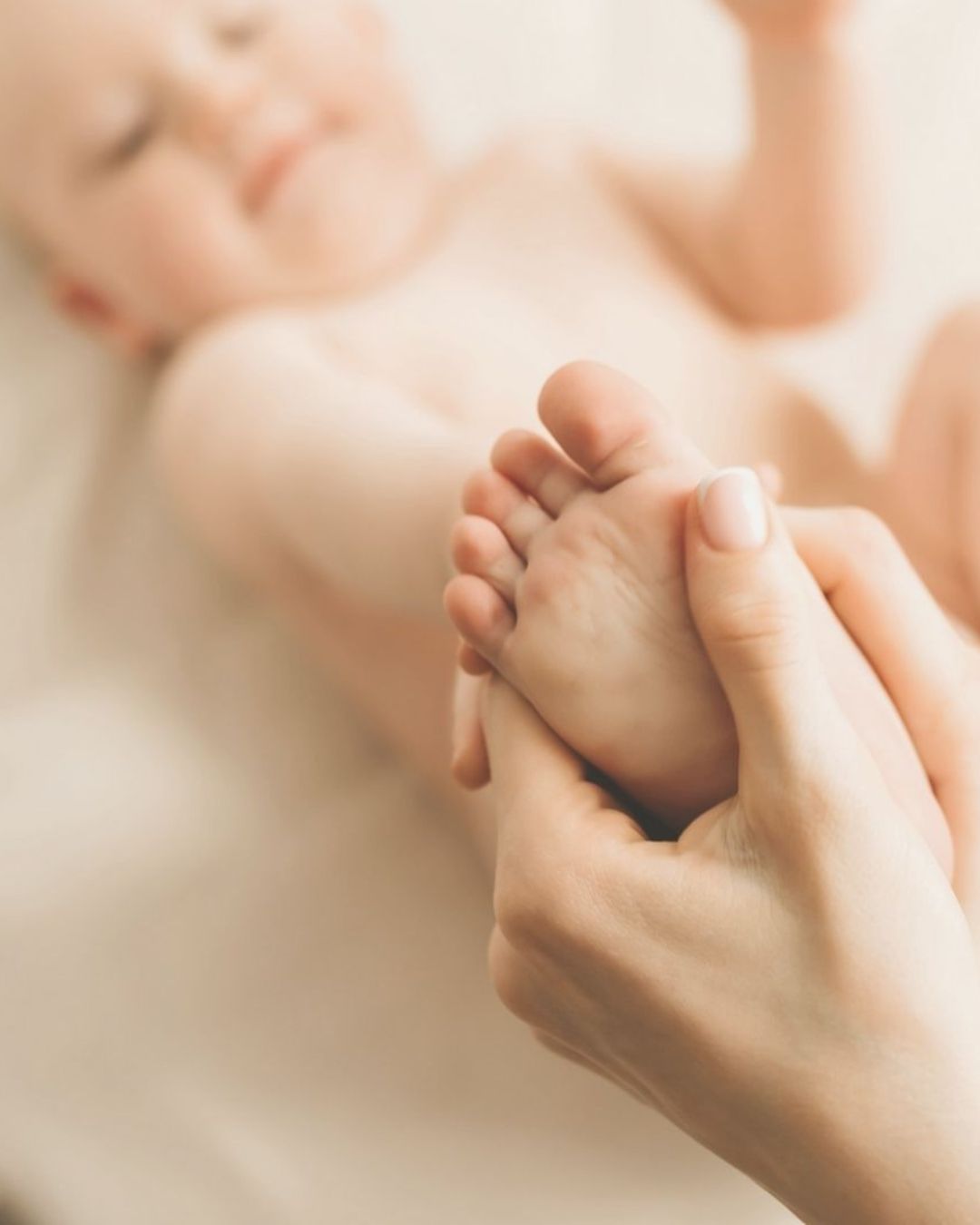

If baby massage sounds like a lovely but optional extra to you, I want to change your mind with the research, not just my opinion. Over a hundred published studies now exist on infant massage, and the effects they document are not soft, vague, or anecdotal. They’re measured on heart-rate monitors and in cortisol samples, and they are remarkably consistent.
It lowers your baby’s stress hormone, measurably, in one session
A single fifteen-minute session of moderate-pressure massage measurably increases a baby’s parasympathetic, calming, nervous system activity and lowers their cortisol, detectable on a heart-rate monitor after just that one session. This is not a cumulative, wait-and-see effect. It is visible the first time you do it correctly.
It works on you at the same time, this is the part that surprises mothers
In research where mothers practiced regular massage with their babies over several weeks, both the mother’s mood scores and the baby’s growth measurements improved significantly. Massage is one of the only interventions in all of infant care that has been shown to measurably help two nervous systems in the same fifteen minutes, yours and your baby’s.
Brief nurturing touch also raises oxytocin in both parent and infant, the same hormone responsible for bonding and for lowering anxiety.
The “wow” fact: your baby’s massage response is visible on a heart monitor within minutes
This is the detail that tends to stop mothers mid-scroll. The vagus nerve, the great calming nerve that runs from your brainstem through your heart and gut, responds to moderate, unhurried pressure specifically. Too light a touch (a feathery stroke) can actually be under-stimulating or even slightly irritating to an infant’s nervous system; a firmer, slower, confident stroke is what activates the calming vagal response. This is why the phrase I teach in every training is “slow and confident, not light and tickly”, the science backs that instruction precisely.
What it does for development, not just for the moment
Beyond the immediate calming effect, regular loving touch in infancy is one of the foundational inputs of secure attachment, and secure attachment at around 18 months is associated with significantly better emotional regulation across childhood and into adulthood, replicated across dozens of long-term studies. Massage is not separate from “brain development” as a category, for an infant, touch, connection, and neurological wiring are the same conversation.
What this means for how you do it
Little and often beats long and rare. Three minutes of confident, slow strokes, most days, will do more for your baby’s nervous system than an occasional twenty-minute session you feel too tired to repeat. The research rewards consistency, not duration.
With care, Gayle.