
You cannot force a milestone. But you can build the foundation beneath it.
When mothers ask me, “When will my baby roll?” or “Why isn’t she sitting yet?”, I hear the unspoken question underneath: Am I doing enough?
Here is what I want you to know: Your baby’s body is not a project. It is not behind schedule. And movement milestones are not achievements to unlock, they are the natural expression of a nervous system that feels safe, connected, and ready.
Baby yoga-inspired movement does not make your baby roll, sit, or crawl. It creates the neurological and muscular conditions that allow those movements to emerge when your baby’s system is ready.
This is the difference between pushing and supporting. And it changes everything.
What Baby Yoga Actually Is (And Isn’t)
Baby yoga is not about stretching your baby into positions or practicing poses. It is a series of gentle, playful, yoga-inspired movements that:
Support nervous system integration (helping your baby process sensory input and develop body awareness)
Build core stability and muscle tone (the foundation for all movement)
Encourage cross-body coordination (necessary for crawling and later walking)
Regulate your baby’s arousal state (calming or alerting, depending on what they need)
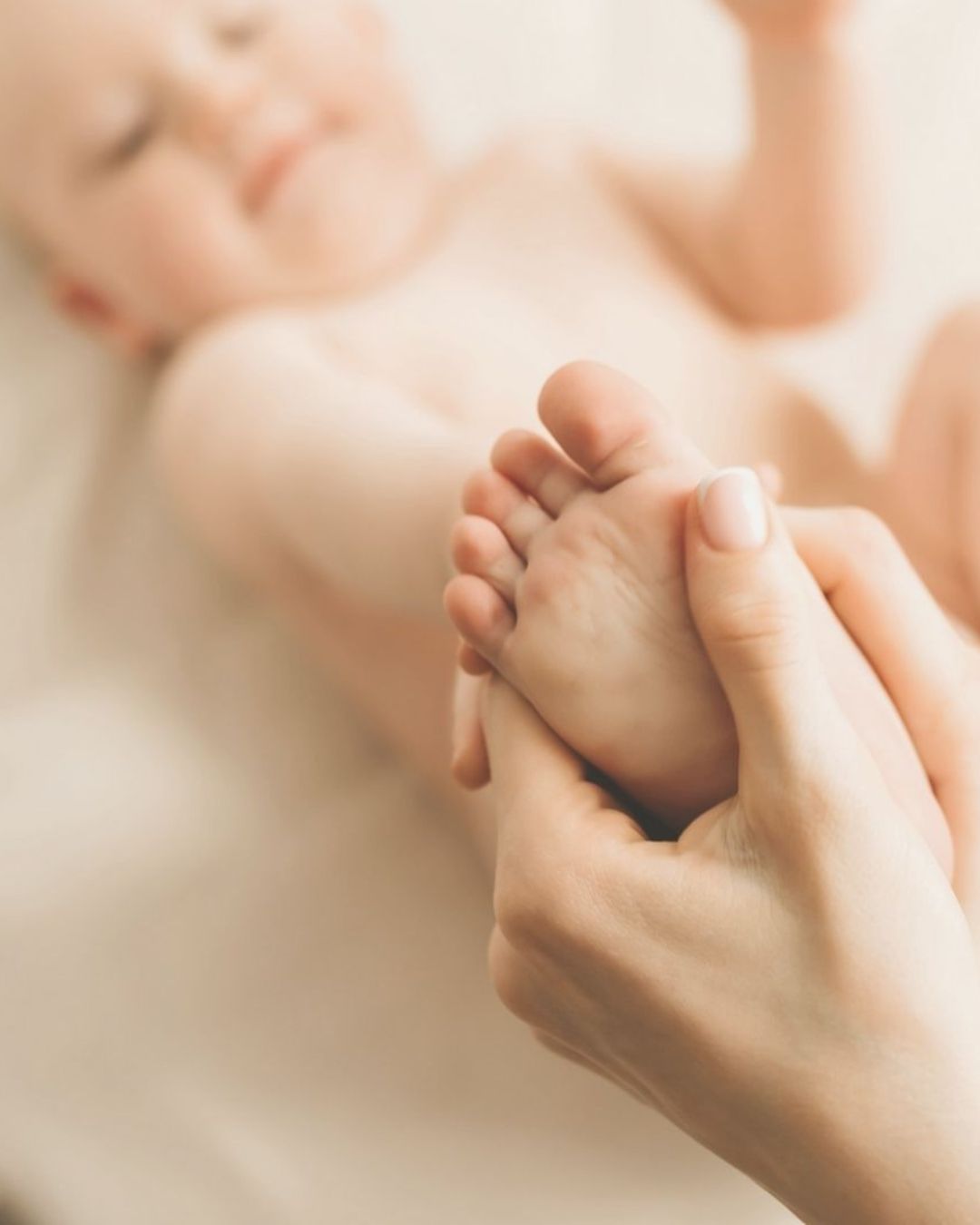
These movements are done with your baby, not to your baby. Your hands guide. Your voice narrates. Your presence regulates.
The practice itself is co-regulation in action.
The Science: Why Movement Matters for Brain Development
Your baby’s brain develops from the bottom up. The brainstem (responsible for survival and regulation) develops first. Then the limbic system (emotion and attachment). Then the cortex (thinking and planning).
Movement is how the brainstem organizes itself.
When your baby moves, whether through tummy time, gentle stretches, or assisted yoga movements, their brain is receiving crucial sensory feedback:
Where is my body in space?
How does this muscle connect to that one?
What happens when I shift my weight?
This sensory input builds proprioception (body awareness) and vestibular integration (balance and spatial orientation), the two systems that underlie all coordinated movement.
Research from the Touch Research Institute (University of Miami) shows that babies who receive regular gentle movement and touch interventions demonstrate improved motor development, better sleep, and lower stress hormones (Diego et al., 2005).
But here’s what matters more: A regulated nervous system moves more freely.
When your baby feels safe in their body, when they are not stressed, overstimulated, or disconnected, their system naturally explores movement. Rolling happens. Sitting emerges. Crawling unfolds.
Your job is not to train the milestone. Your job is to create the conditions for it.
How Baby Yoga Supports Each Milestone
Rolling (4-6 months, on average)
Rolling requires:
Core strength (to lift the head and initiate the turn)
Cross-body coordination (to reach across the midline)
Confidence (to shift weight and trust the movement)
What baby yoga does:
Gentle twists and side-lying stretches build the muscles needed for rotation
Cross-body movements (bringing right hand to left foot) integrate both sides of the brain
Your calm presence reduces the fear that can block new movement
Try this: Lay your baby on their back. Gently guide their right hand across their body toward their left hip. Narrate what you’re doing: “We’re reaching across. Feel that stretch?” This is not forcing, it’s inviting their nervous system to explore the pathway.
Sitting (6-8 months, on average)
Sitting requires:
A strong, stable core
Head and neck control
Balance and postural awareness
What baby yoga does:
Supported sitting positions (with your hands gently holding their hips) allow their core to strengthen gradually
Gentle forward folds and back extensions build the muscles along the spine
Rocking movements develop vestibular (balance) input
Try this: Sit your baby between your legs, facing out. Support them at the hips (not the armpits, we want their core to work). Gently rock side to side. This teaches their body how to respond to shifts in balance.
Crawling (7-10 months, on average)
Crawling requires:
All of the above, plus:
Bilateral coordination (both sides of the body working together)
Weight-shifting confidence
Spatial awareness
What baby yoga does:
“All fours” positions (supported on hands and knees) build strength and confidence in that posture
Movements that encourage pushing through the hands and feet develop the pressure needed for propulsion
Playful sequences keep your baby engaged long enough to build endurance
Try this: Place your baby on their belly. Gently press the soles of their feet against your palms, this gives them something to “push” against, which is how crawling begins.
The Piece Nobody Talks About: Nervous System Readiness
Here is what the milestone apps will not tell you:
A baby who is chronically stressed, overstimulated, or disconnected may not move freely, even if their muscles are strong enough.
Because movement requires safety.
When the nervous system is in a state of threat (even low-level, chronic stress), the body prioritizes survival over exploration. Rolling, sitting, and crawling are acts of exploration. They require a ventral vagal state, the part of the nervous system that says, It is safe to play. It is safe to try.
This is why your regulation matters.
When you are calm, present, and connected during movement practice, your baby’s nervous system receives the message: This is safe. You can explore.
When you are anxious, rushing, or focused on the milestone as a measure of success, your baby feels that too.
The movement practice works best when it is an invitation, not an intervention.
What to Do (And What Not to Do)
DO:
Practice baby yoga when your baby is in a calm-alert state (not hungry, not tired, not overstimulated)
Follow your baby’s cues, if they pull away, fuss, or stiffen, stop and try again later
Keep sessions short (5-10 minutes is enough)
Narrate what you’re doing in a calm, rhythmic voice
Make it playful, sing, smile, make eye contact
DON’T:
Force any movement your baby resists
Compare your baby’s timeline to another baby’s
Practice when you are stressed (your baby will mirror your nervous system)
Use baby yoga as a “fix” for a milestone delay, if you have concerns, speak to a pediatrician or physiotherapist
When to Start
You can begin gentle baby yoga-inspired movement as early as 6 weeks postpartum (once your baby has head control). But the practice evolves as your baby grows.
6 weeks, 3 months: Gentle stretches, bicycle legs, and touch-based movements
3, 6 months: More dynamic movements, supported sitting, side-lying stretches
6, 12 months: All fours positions, weight-shifting, crawling preparation
The key is this: You are not working toward a milestone. You are working with your baby’s developing nervous system.
The Truth About Timelines
Milestones have ranges, not deadlines. Rolling can happen anywhere from 4 to 6 months. Sitting can emerge between 6 and 9 months. Crawling may appear at 7 months, or 11 months, or your baby may skip it entirely and go straight to walking.
All of this can be normal.
What matters more than when is how: Is your baby exploring movement with curiosity? Are they responsive and engaged? Is their body relaxed, or chronically tense?
If you are worried, trust that instinct. Speak to your pediatrician or a pediatric physiotherapist. You are not being “dramatic”, you are being attentive.
But if your baby is progressing at their own pace, meeting your eyes, responding to your voice, and exploring their body, you are doing enough.
The Practice Is the Point
Baby yoga is not about producing a milestone. It is about being with your baby in their body.
It is about teaching them, through your hands, your breath, your presence, that movement is safe. That their body is good. That exploring the world is something they are allowed to do.
The rolling will come. The sitting will come. The crawling will come.
But what your baby will remember, in their bones, in their nervous system, in the foundation of who they become, is that you were there. Meeting them. Moving with them. Holding them through it all.
Because love creates love. And movement, when it is held in love, creates confidence.
References:
Diego, M. A., Field, T., & Hernandez-Reif, M. (2005). Vagal activity, gastric motility, and weight gain in massaged preterm neonates. Journal of Pediatrics, 147(1), 50-55.
Adolph, K. E., & Franchak, J. M. (2017). The development of motor behavior. Wiley Interdisciplinary Reviews: Cognitive Science, 8(1-2).
Porges, S. W. (2011). The Polyvagal Theory: Neurophysiological Foundations of Emotions, Attachment, Communication, and Self-Regulation. W.W. Norton & Company.
Create Blog Post 5: ‘Why your baby cries at the same time every night’
Create Blog Post 6: ‘The nap transition nobody warns you about’
Create Blog Post 7: ‘Why your baby sleeps better after a walk outside’
Create Blog Post 8: ‘You are not a project manager for your baby’
Create Blog Post 9: ‘Why motherhood feels so lonely, even in a full house’
Create Blog Post 10: ‘You were already enough before the first app’
Create Blog Post 11: ‘The 3am hour, and what it is asking of you’
Create Blog Post 12: ‘Your baby is borrowing your nervous system’
Create Blog Post 13: ‘The first forty days: a different kind of fourth trimester’